
UPVC doors and windows have become one of the most popular building materials in modern construction due to their good insulation, soundproofing, corrosion resistance and long service life. The production of high-quality PVC and UPVC doors and windows cannot be completed without professional welding equipment. Among them, the PVC door and window welding machine is the core machine in the whole production line.
This article will explain the working principle, main types, structure features, application advantages and selection tips of PVC door and window welding machines, helping manufacturers, engineers and buyers choose the right equipment for their production.
What Is a PVC Door and Window Welding Machine?
A PVC door and window welding machine is a special thermofusion machine used to connect PVC or UPVC profiles. It uses heating plates to melt the ends of plastic profiles and combines them under stable pressure. After cooling and solidifying, the profiles form a strong integrated frame.
Compared with manual bonding or mechanical connection, professional welding provides higher strength, better airtightness and more stable appearance. This machine is widely used in small workshops, medium factories and large automatic production lines for doors and windows.
Working Principle of PVC Welding Machines
The working process of a standard PVC welding machine includes four stable steps:
Clamping
The PVC profiles are placed in the positioning fixture and fixed by pneumatic or hydraulic clamping system to avoid movement or deviation.
Heating
The heating plate moves between the two profile ends and heats them at a controlled temperature, usually from 230°C to 260°C, until the surface melts properly.
Butt-jointing
The heating plate withdraws quickly, and the two melted profile ends are pressed together under set pressure to form a firm connection.
Cooling and forming
The welded joint cools down and solidifies. After cooling, the fixture releases and the welded frame can be taken out.
This automatic cycle ensures stable welding quality in mass production.
Main Types of PVC Door and Window Welding Machines
PVC welding machines are divided into different models according to the number of welding heads, functions and automation levels.
Single Head PVC Welding Machine
Suitable for small-scale production, maintenance and sample making
Compact structure, small floor space, low investment
Can weld single corners of PVC doors and windows
Easy to operate and maintain
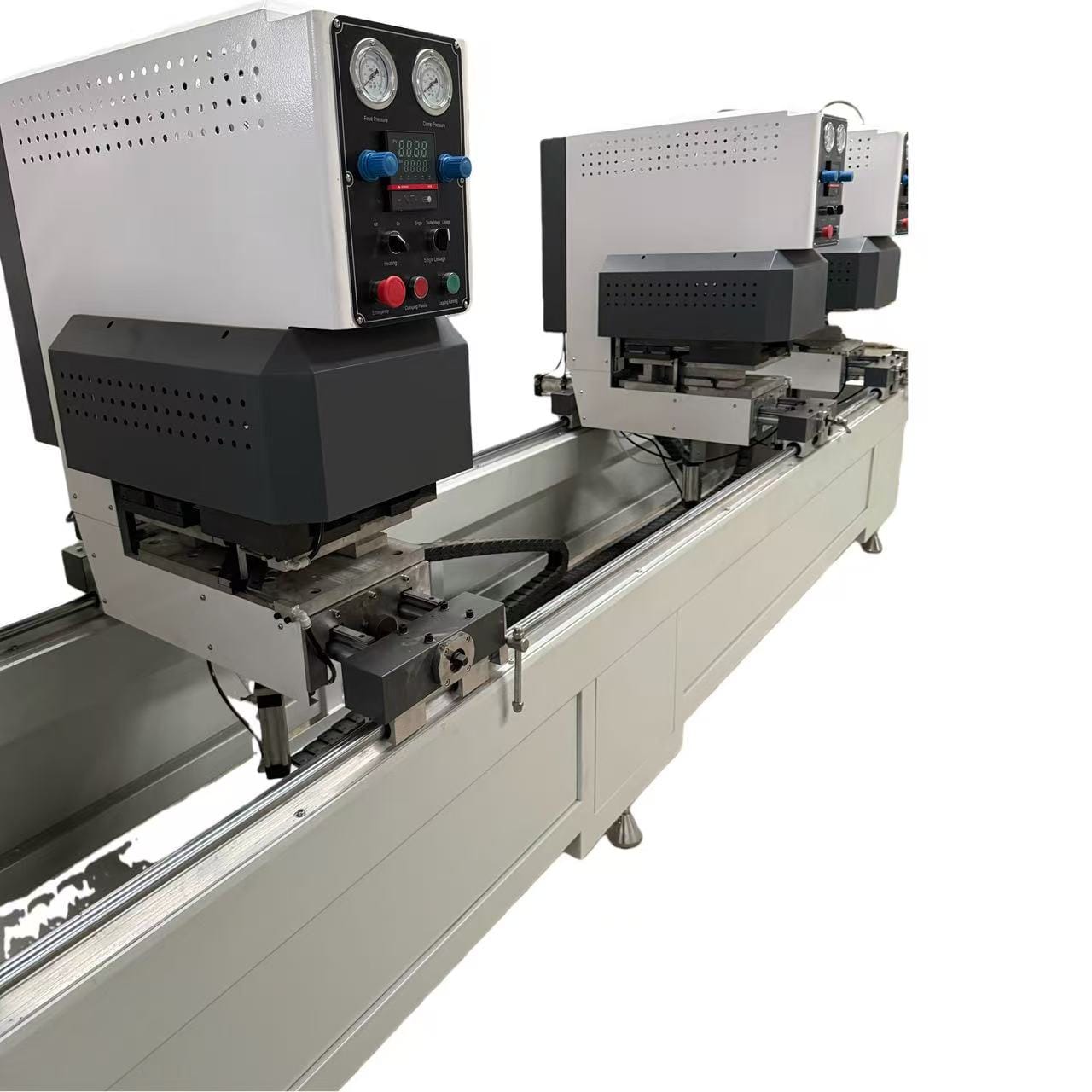
Double Head PVC Welding Machine
This is the most commonly used model for medium and small door and window factories.
Weld two corners at the same time
High efficiency and stable performance
Ideal for standard PVC window and door frames
Cost-effective for most manufacturers
Three Head and Four Head Welding Machines
Designed for large-scale and automatic production lines
Four-head machines can finish a full window frame in one cycle
Greatly improve daily output and product consistency
Widely used in large modern door and window factories
Seamless PVC Welding Machine
Provides seamless welding effect with almost no visible welding line
Improves the appearance and surface smoothness of doors and windows
Ideal for high-end residential and commercial projects
Supports various colors and surface treatments
Automatic and Semi-Automatic Models
Semi-automatic: Needs manual loading and unloading
Automatic: Equipped with automatic conveying and control system
Higher automation reduces labor cost and improves stability
Core Components and Features
A high-quality PVC door and window welding machine includes the following key parts:
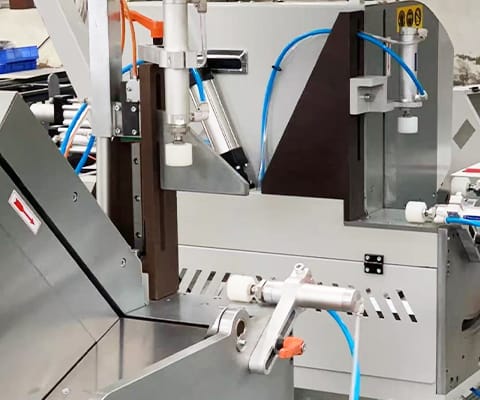
Pneumatic or hydraulic system: Provides stable clamping and welding pressure
Precise temperature control: Ensures consistent melting effect
Positioning fixture: Guarantees accurate 90° right-angle welding
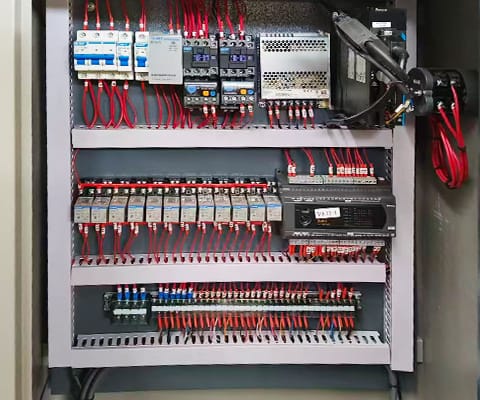
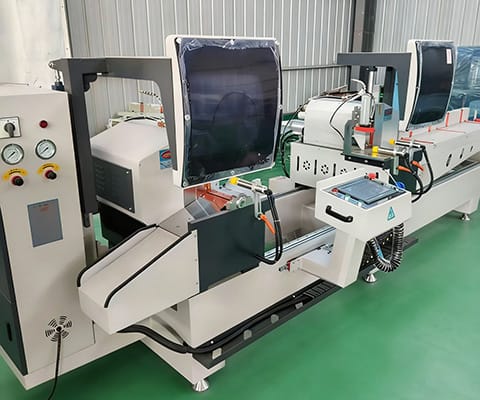
PLC touch screen: Easy parameter setting and fault detection
High-efficiency heating plate: Long service life and uniform heating
Heavy-duty steel frame: Reduces vibration and ensures long-term precision
Advantages of Using Professional PVC Welding Machines
High welding strength
The welded joint has strength close to the original profile, not easy to break or deform.
Better airtightness and watertightness
Thermofusion connection reduces gaps and improves insulation and waterproof performance.
Stable and consistent quality
Machine-controlled parameters reduce errors caused by manual operation.
High production efficiency
Multi-head models can produce hundreds of window frames per day.
Wide compatibility
Suitable for most standard PVC and UPVC profile series in the global market.
How to Choose the Right PVC Door and Window Welding Machine
When choosing a PVC welding machine, you can consider the following points:
Production scale: Small workshops can choose double-head; large factories use four-head automatic lines.
Product level: High-end doors and windows are recommended to use seamless welding machines.
Profile type: Make sure the machine matches your profile size and structure.
Control system: PLC touch screen is more stable and user-friendly.
Brand and after-sales service: Reliable manufacturers provide better quality and support.
Conclusion
The PVC door and window welding machine is essential equipment for producing high-quality UPVC doors and windows. From single-head to four-head, from semi-automatic to fully automatic and seamless models, different machines meet different production needs.
With the global demand for energy-saving and high-performance building materials continuing to rise, PVC welding machines will develop towards higher automation, intelligence and precision, helping manufacturers improve product quality and market competitiveness.