
Aluminum Profile Oblique Cutting Saw: The Ultimate Guide to Precision, Types & Selection
Keywords: Aluminum profile oblique cutting saw, aluminum oblique cutting machine, precision aluminum cutting saw, aluminum window cutting machine, aluminum profile miter saw, double-head aluminum cutting saw
Keywords: Aluminum profile oblique cutting saw, aluminum oblique cutting machine, precision aluminum cutting saw, aluminum window cutting machine, aluminum profile miter saw
Aluminum profiles have become indispensable in modern construction, furniture manufacturing, and industrial applications—from window and door frames to curtain walls, railings, and automotive components. Achieving clean, accurate, and angled cuts is critical to ensuring the quality and durability of aluminum products, and this is where the aluminum profile oblique cutting saw shines. As a specialized cutting tool designed for aluminum profiles, it delivers precise miter cuts, smooth edges, and consistent performance, making it a cornerstone of aluminum processing workshops and production lines.
This comprehensive, original technical guide breaks down everything you need to know about aluminum profile oblique cutting saws—including their working principle, key types, core components, technical advantages, and expert selection tips. Whether you’re a manufacturer, engineer, workshop owner, or buyer, this article will help you understand how to leverage this equipment for optimal cutting results and operational efficiency.
What Is an Aluminum Profile Oblique Cutting Saw?
An aluminum profile oblique cutting saw (also known as an aluminum miter saw or aluminum oblique cutting machine) is a specialized power tool designed to make precise angled (oblique) cuts on aluminum profiles of various sizes and thicknesses. Unlike standard straight cutting saws, it can adjust the cutting angle (typically 0° to 45°, and sometimes up to 60°) to meet the requirements of aluminum assembly—such as joining window frames, door sashes, or railings at perfect miter joints.
Built specifically for aluminum’s unique properties—lightweight, malleable, and prone to burring—this saw features specialized blades, cooling systems, and clamping mechanisms to ensure clean, burr-free cuts without damaging the profile’s surface. It is widely used in aluminum door and window manufacturing, curtain wall processing, furniture production, and other industries that require high-precision aluminum cutting.
Working Principle of Aluminum Profile Oblique Cutting Saws
The working principle of an aluminum profile oblique cutting saw is based on controlled, high-speed blade rotation combined with adjustable angle positioning and stable clamping. The core process can be broken down into four key steps, ensuring precision and consistency:
Positioning & Angle Adjustment
First, the operator adjusts the saw’s cutting angle according to the project requirements (e.g., 45° for window frame corners, 30° for railings). Most models feature a graduated angle scale and locking mechanism to ensure the angle remains stable during cutting. The aluminum profile is then placed on the saw’s worktable, aligned with the cutting guide.
Clamping
The profile is securely clamped using a pneumatic or manual clamping system. This step is critical—stable clamping prevents the profile from moving during cutting, which would cause uneven cuts, burrs, or even safety hazards. High-quality saws feature adjustable clamping pressure to accommodate different profile thicknesses without damaging the aluminum surface.
Cutting
Once positioned and clamped, the high-speed circular blade (specialized for aluminum cutting) is activated. The blade rotates at speeds ranging from 2,800 to 4,500 RPM, depending on the saw model and profile thickness. The operator feeds the profile into the blade (or lowers the blade onto the profile, depending on the saw type) to make the oblique cut. The blade’s specialized teeth—designed to minimize burring—slice through the aluminum cleanly.
Cooling & Deburring
Aluminum generates heat during cutting, which can warp the profile or damage the blade. Most aluminum profile oblique cutting saws are equipped with a cooling system (either air cooling or water cooling) to dissipate heat. Some models also include a built-in deburring tool to remove any small burrs left after cutting, ensuring a smooth, ready-to-assemble edge.
Main Types of Aluminum Profile Oblique Cutting Saws
Aluminum profile oblique cutting saws are categorized by their structure, automation level, and cutting capacity to suit different production needs—from small workshops to large-scale automated lines. Below are the most common types:
Manual Aluminum Profile Oblique Cutting Saw
• Best for: Small-scale workshops, hobbyists, or low-volume production (e.g., custom window repairs, small batch orders).• Features: Compact design, low cost, easy to operate; angle adjustment and clamping are done manually. Ideal for profiles with small cross-sections (up to 100mm x 100mm).• Use Case: Small aluminum door and window workshops, home DIY projects, or on-site maintenance.
Semi-Automatic Aluminum Oblique Cutting Saw
• Best for: Medium-volume production (e.g., small to medium-sized aluminum door and window factories).• Features: Pneumatic clamping (reduces manual labor), adjustable cutting speed, and a fixed worktable. The blade is lowered manually or via a hydraulic lever, while clamping is automated. Can handle larger profiles (up to 150mm x 150mm).• Use Case: Standard aluminum window and door production, railing manufacturing.
Automatic Aluminum Profile Oblique Cutting Saw
• Best for: Large-scale, high-volume production lines (e.g., industrial aluminum processing, mass-produced window frames).• Features: Fully automated with PLC control, automatic feeding, clamping, cutting, and cooling. Equipped with a conveyor system to move profiles through the cutting process, minimizing human error and maximizing efficiency. Can handle large cross-section profiles (up to 200mm x 200mm or larger).• Use Case: Large aluminum manufacturing plants, curtain wall processing factories, automotive aluminum component production.
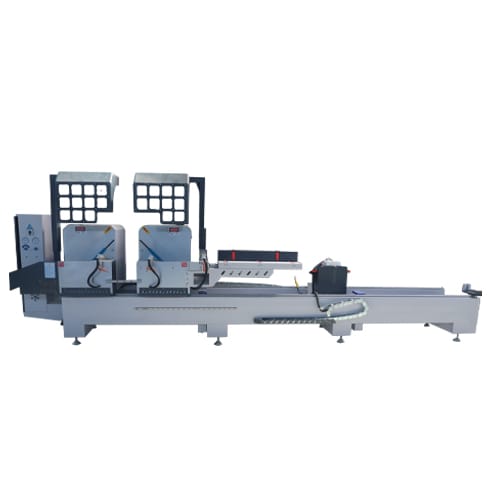
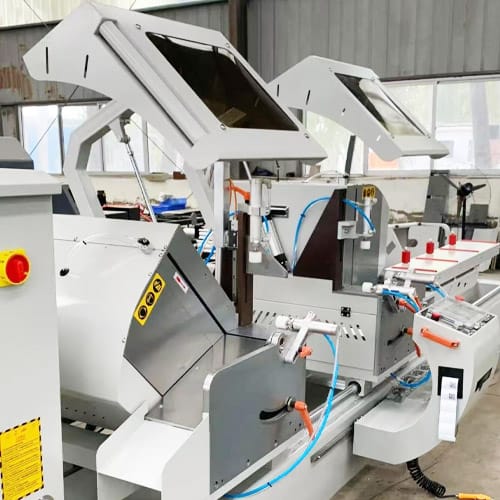
Double-Head Aluminum Oblique Cutting Saw
• Best for: High-efficiency production of frame components (e.g., window frames, door sashes).• Features: Two saw heads positioned at adjustable angles (usually 45° on both sides) to cut both ends of a profile simultaneously. This drastically reduces cycle time and ensures consistent angle accuracy between the two ends.• Use Case: Mass production of aluminum window and door frames, where speed and precision are critical.
Core Components & Technical Features
The performance and precision of an aluminum profile oblique cutting saw depend on its core components. High-quality models feature the following key parts, designed to optimize cutting accuracy and durability:
Cutting Blade
The blade is the most critical component—specialized for aluminum cutting, it typically has carbide-tipped teeth (for wear resistance) and a thin kerf (to minimize material waste and burring). Blade diameter ranges from 300mm to 500mm, depending on the saw’s cutting capacity. The number of teeth varies (60–120 teeth):fewer teeth for faster cutting, more teeth for smoother edges.
Worktable & Positioning Guide
A flat, rigid worktable (usually made of cast iron or aluminum alloy) ensures stable profile placement. The positioning guide (angle ruler or laser guide) helps align the profile accurately, while a scale marks the cutting length for consistent results. Some high-end models include a laser positioning system for enhanced precision.
Clamping System
Available in manual, pneumatic, or hydraulic versions. Pneumatic/hydraulic clamping provides uniform pressure, preventing profile movement and surface damage. Adjustable clamping jaws accommodate different profile shapes (square, rectangular, or irregular).
Cooling System
Air cooling (for small saws) or water cooling (for large, high-speed models) dissipates heat generated during cutting. Water cooling also helps reduce burring and extends blade life by keeping the blade temperature low.
Control System
Manual/semi-automatic models have a simple control panel for adjusting speed and angle. Automatic models feature a PLC touch screen for programming cutting parameters (angle, length, speed) and monitoring production status, enabling fully automated operation.
Frame Structure
A heavy-duty steel or cast iron frame reduces vibration during cutting—vibration is a major cause of uneven cuts and blade wear. A stable frame ensures long-term precision and durability.
Key Advantages of Using a Professional Aluminum Profile Oblique Cutting Saw
Compared to general-purpose cutting tools (e.g., circular saws), a specialized aluminum profile oblique cutting saw offers distinct advantages that make it essential for aluminum processing:
Precision & Consistency
Designed specifically for aluminum, it delivers accurate angle cuts (error ≤ 0.1°) and smooth edges, ensuring seamless assembly of aluminum components. The adjustable angle locking mechanism and positioning guides guarantee consistent results across every cut.
Burr-Free Cutting
Specialized carbide blades and optimized cutting speeds minimize burring, reducing the need for post-cut deburring and saving time. This is critical for high-quality aluminum products, where rough edges can compromise structural integrity and aesthetics.
Efficiency & Productivity
Semi-automatic and automatic models reduce manual labor, cutting cycle times by 30–50% compared to manual tools. Double-head models further boost efficiency by cutting both ends of a profile simultaneously.
Versatility
Adjustable cutting angles (0°–45°+) and compatible with various aluminum profile sizes (from small decorative profiles to large structural profiles) make it suitable for a wide range of applications—from window frames to curtain walls, railings, and furniture.
Durability & Longevity
Heavy-duty frames, high-quality blades, and corrosion-resistant components (adapted to aluminum’s properties) ensure the saw can withstand long-term, high-volume use. Proper maintenance extends the machine’s lifespan to 5–10 years.
How to Choose the Right Aluminum Profile Oblique Cutting Saw
Selecting the right saw depends on your production scale, product requirements, and budget. Follow these expert tips to make an informed decision:
Assess Production Scale
• Small-scale/low-volume: Choose a manual or semi-automatic saw (cost-effective, easy to maintain).• Medium-volume: Opt for a semi-automatic saw with pneumatic clamping (balances efficiency and cost).• Large-scale/high-volume: Invest in an automatic or double-head saw (maximizes productivity and consistency).
Consider Cutting Capacity
Check the saw’s maximum profile cross-section (width x height) and cutting length to ensure it can handle your typical aluminum profiles. For example, window frames often require saws that can cut 120mm x 80mm profiles, while curtain walls may need larger capacity (200mm x 150mm).
Prioritize Precision Requirements
If your products require tight angle tolerances (e.g., high-end window frames), choose a saw with a laser positioning system, rigid frame, and precise angle adjustment (error ≤ 0.1°). For general applications, a standard semi-automatic saw will suffice.
Evaluate Automation Level
Manual saws are ideal for small batches or custom work. Semi-automatic saws reduce labor but require operator oversight. Automatic saws are best for mass production, as they minimize human error and maximize output.
Check Blade Quality & Compatibility
Ensure the saw uses high-quality carbide-tipped blades specialized for aluminum. Look for models with easy blade replacement, as blades wear over time and need periodic replacement.
Consider Brand & After-Sales Service
Choose reputable manufacturers with ISO/CE certifications—their saws are more reliable and durable. Prioritize brands that offer timely after-sales support (e.g., blade replacement, maintenance, and repair services), as downtime can impact production.
Conclusion
The aluminum profile oblique cutting saw is an essential tool for precision aluminum processing, delivering clean, accurate, and efficient cuts that are critical to high-quality aluminum products. From manual models for small workshops to fully automatic double-head machines for large-scale production, there is a saw to suit every need.
As the demand for aluminum products grows in construction, furniture, and industrial sectors, the role of the aluminum profile oblique cutting saw will only become more important. By understanding its working principle, types, and selection criteria, you can choose the right equipment to improve production efficiency, reduce costs, and deliver superior products that stand out in the market.