
UPVC Double-Sided Seamless Welding: Technology, Advantages & Machine Guide
Keywords: UPVC double-sided seamless welding, double-sided seamless welding machine, UPVC seamless welding technology, UPVC profile seamless welding, high-end UPVC window welding
In the UPVC door and window manufacturing industry, the pursuit of high quality, aesthetics, and durability has driven the continuous upgrading of welding technology. Among the latest innovations, UPVC double-sided seamless welding stands out as a game-changer, solving the long-standing problem of visible welding seams, poor smoothness, and insufficient strength in traditional UPVC welding. This technology not only enhances the visual appeal of UPVC doors and windows but also improves their structural stability, airtightness, and service life, making it the preferred choice for high-end construction projects and premium product lines.
This original, comprehensive guide will break down everything you need to know about UPVC double-sided seamless welding—from its core definition and working principle to its unique advantages, key equipment features, application scenarios, and practical operation tips. Whether you’re a UPVC manufacturer, engineer, or buyer, this article will help you fully understand this advanced technology and leverage it to enhance product competitiveness.
What Is UPVC Double-Sided Seamless Welding?
UPVC double-sided seamless welding is an advanced thermofusion technology designed specifically for joining UPVC profiles, focusing on eliminating visible welding seams on both sides of the profile joint (internal and external surfaces). Unlike traditional welding methods that leave a noticeable groove or protrusion after trimming, this technology uses specialized equipment and precise process control to melt UPVC profiles and fuse them seamlessly, resulting in a smooth, flat joint that is almost invisible to the naked eye
This technology is mainly applied to UPVC door and window frames, curtain walls, and other profiles that require high aesthetic standards and structural strength. It addresses the drawbacks of traditional welding—such as dirt accumulation in weld grooves, color fading at the joint, and reduced structural integrity—by creating a uniform, seamless connection that matches the original profile’s surface texture and colorhttps://www.precisaw.com/product/upvc-profile-double-sided-welding-machine/
How Does UPVC Double-Sided Seamless Welding Work?
UPVC double-sided seamless welding follows a precise, automated process that combines heating, fusion, and seamless trimming, ensuring consistent results across every joint. The core process can be divided into five key steps, which are optimized to eliminate seams on both sides of the profile:
1. Profile Positioning & Clamping
First, the UPVC profiles are placed on a precision worktable and aligned at the required angle (usually 45° for window corners). A dual-sided pneumatic clamping system securely fixes the profiles, ensuring no movement during welding. The clamping pressure is adjustable to avoid damaging the profile surface, especially for colored or foiled UPVC profiles
2. Preheating & Temperature Control
The profiles are preheated to a controlled temperature (typically 230–260°C) using a dual-sided heating plate. This preheating ensures uniform melting of the profile ends, which is critical for seamless fusion. High-quality welding machines use PLC control (often from Japanese Omron) to maintain precise temperature stability, preventing overheating or underheating
3. Double-Sided Fusion
The heated profiles are pressed together under calibrated pressure, allowing the molten UPVC material to fuse seamlessly. Unlike traditional welding, double-sided seamless welding uses a “material backflow” design—excess molten material is pushed back into the hollow chambers of the profile, rather than being trimmed off, ensuring no gaps or grooves on either side of the joint
4. Synchronous Double-Sided Trimming
For any minimal excess material that remains, specialized alloy cutting knives (processed by high-frequency quenching) trim both the internal and external sides of the joint simultaneously. This synchronous trimming ensures the joint is flat and smooth on both sides, with no visible seams or burrs. The cutting knives are standardized and easily replaceable, reducing maintenance time
5. Cooling & Solidification
The welded joint is cooled using an air or water cooling system, ensuring rapid solidification while maintaining the joint’s shape and strength. The cooling time is typically around 25 seconds, and the entire welding cycle for a single corner takes approximately 2 minutes, making it efficient for mass productionhttps://www.precisaw.com/product/upvc-profile-double-sided-welding-machine/
Key Advantages of UPVC Double-Sided Seamless Welding
Compared to traditional UPVC welding methods (such as standard mitre welding with trimming), double-sided seamless welding offers distinct advantages that make it ideal for high-end products. These advantages directly address the pain points of traditional welding and enhance product value:
1. Perfect Aesthetic Finish (No Visible Seams)
The most significant advantage is the invisible double-sided joint—both the internal and external surfaces of the profile are smooth and flat, with no grooves, protrusions, or burrs. This eliminates the need for manual touch-up (such as coloring gaps in foiled profiles) and mimics the sleek appearance of wooden or aluminum frames, meeting the demand for modern, minimalist design
2. Enhanced Structural Strength
The seamless fusion process creates a joint with strength equal to or higher than the original UPVC profile. The dual-sided clamping and material backflow design ensure the joint is fully integrated, reducing the risk of breakage, deformation, or water leakage. This is especially critical for large window frames or high-rise building applications
3. Improved Airtightness & Watertightness
Without visible seams or grooves, there are no gaps for air, water, or dust to enter. This significantly improves the airtightness and watertightness of UPVC doors and windows, enhancing their energy efficiency and sound insulation performance. It also reduces maintenance needs, as there are no grooves to collect dirt or algae
4. Time & Labor Savings
The automated double-sided welding and trimming process eliminates the need for manual post-welding trimming and touch-up. A single machine can complete a corner weld in 2 minutes, with an annual output of 8,000–10,000 square meters per single shift—greatly improving production efficiency and reducing labor costs
5. Compatibility with Colored & High-End Profiles
Double-sided seamless welding is ideal for colored, foiled, or textured UPVC profiles. Traditional trimming often cuts through the foil or texture, revealing the white base material, but seamless welding avoids this issue, preserving the profile’s original appearance and color consistencyhttps://www.precisaw.com/product/upvc-profile-double-sided-welding-machine/
UPVC Double-Sided Seamless Welding Machines: Core Features
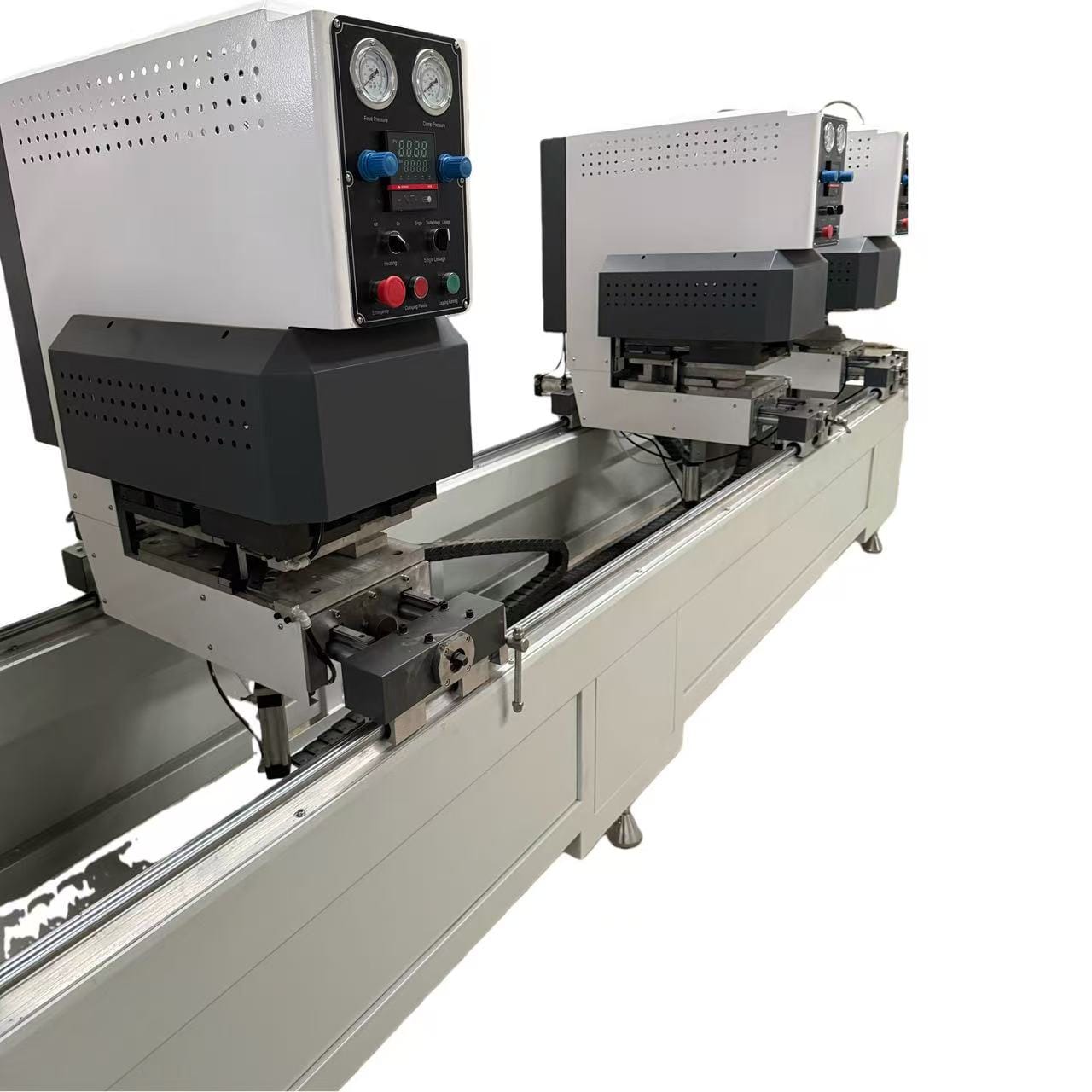
The performance of UPVC double-sided seamless welding depends entirely on the quality of the specialized welding machine. High-quality machines feature the following core components and features to ensure precise, consistent results:
1. Dual-Sided Heating & Trimming System
Equipped with dual-sided heating plates for uniform melting and dual-sided alloy cutting knives for synchronous trimming. The heating plates are made of high-temperature-resistant materials, while the cutting knives are hardened for durability and easy replacement
2. PLC Automatic Control System
Adopts programmable logic controllers (PLC) from reputable brands (e.g., Omron, Schneider) to control temperature, pressure, heating time, and cooling time. The touch screen interface allows for easy parameter adjustment and fault detection, ensuring stable, reliable operation
3. Dual-Sided Pneumatic Clamping
Features main and auxiliary compression clamps to provide stable, uniform pressure. This prevents profile deformation during welding and ensures accurate angle alignment (90° or 45°) for perfect joints
4. Precision Worktable & Positioning Guide
A heavy-duty cast iron worktable reduces vibration during welding, while a laser positioning guide ensures accurate profile alignment. The worktable can accommodate profiles of various sizes (height 20–120mm, length 400–3500mm)
5. Efficient Cooling System
Air or water cooling systems dissipate heat quickly, ensuring rapid solidification of the joint without warping. This also extends the service life of the heating plates and cutting knives
Application Scenarios of UPVC Double-Sided Seamless Welding
Due to its superior aesthetic and performance advantages, UPVC double-sided seamless welding is widely used in high-end and demanding applications. The main application scenarios include:
1. High-End Residential UPVC Doors & Windows
Ideal for luxury villas, high-end apartments, and residential projects where aesthetics and quality are prioritized. The seamless joints enhance the overall appearance of the building and improve energy efficiency[superscript:2]
2. Commercial & Public Buildings
Used in office buildings, shopping malls, hotels, and hospitals, where durability, airtightness, and low maintenance are critical. The seamless joints resist dirt and corrosion, ensuring long-term performancehttps://www.precisaw.com/product/upvc-profile-double-sided-welding-machine/
3. Colored & Textured UPVC Products
Perfect for colored, foiled, or wood-grain textured UPVC profiles, as it preserves the profile’s surface integrity and color consistency—eliminating the unsightly gaps caused by traditional trimming
4. Specialized UPVC Components
Applied to UPVC curtain walls, railings, and custom profiles, where structural strength and aesthetic appeal are equally important. The seamless welding ensures the components can withstand harsh environmental conditions
How to Choose a UPVC Double-Sided Seamless Welding Machine
Selecting the right welding machine is critical to achieving high-quality double-sided seamless welding. Consider the following key factors when making a purchase:
1. Production Scale
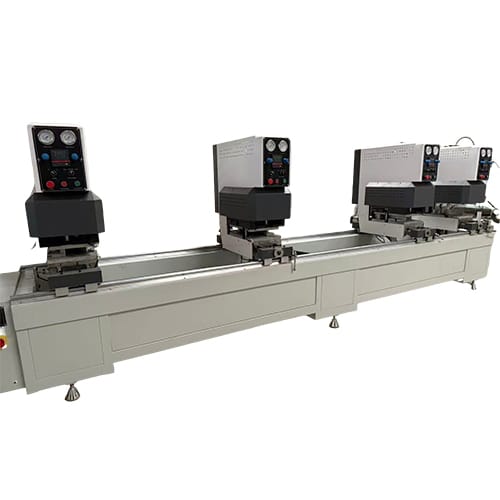
• Small to medium-scale production: Choose a double-head double-sided seamless welding machine (cost-effective, efficient for standard window frames)[superscript:1][superscript:6]. • Large-scale mass production: Opt for a four-head machine, which can weld a full window frame in one cycle, maximizing outputhttps://www.precisaw.com/product/upvc-profile-double-sided-welding-machine/
2. Profile Specifications
Ensure the machine can accommodate your profile size (height, width, length). Most machines support profiles with height 20–120mm, width up to 120mm, and length 400–3500mm
3. Automation Level
• Semi-automatic: Suitable for small batches, requires manual loading/unloading. • Fully automatic: Equipped with conveyor systems and PLC control, ideal for mass production, minimizing human error[superscript:1][superscript:8].
4. Core Component Quality
Prioritize machines with high-quality heating plates, alloy cutting knives, and PLC control systems (Omron, Schneider). These components ensure stable performance and long service life[superscript:1][superscript:5].
5. After-Sales Service
Choose manufacturers with ISO/CE certifications and reliable after-sales support (e.g., blade replacement, maintenance, technical training). This reduces downtime and ensures consistent production[superscript:4][superscript:5].
Conclusion
UPVC double-sided seamless welding is transforming the UPVC door and window industry, setting a new standard for quality, aesthetics, and performance. By eliminating visible seams, enhancing structural strength, and improving efficiency, this technology helps manufacturers differentiate their products in the high-end market.
As consumer demand for high-quality, low-maintenance UPVC products continues to grow, double-sided seamless welding will become increasingly essential. Whether you’re upgrading your production line or selecting equipment for a new project, understanding this technology and choosing the right machine will help you achieve superior results and gain a competitive edge.